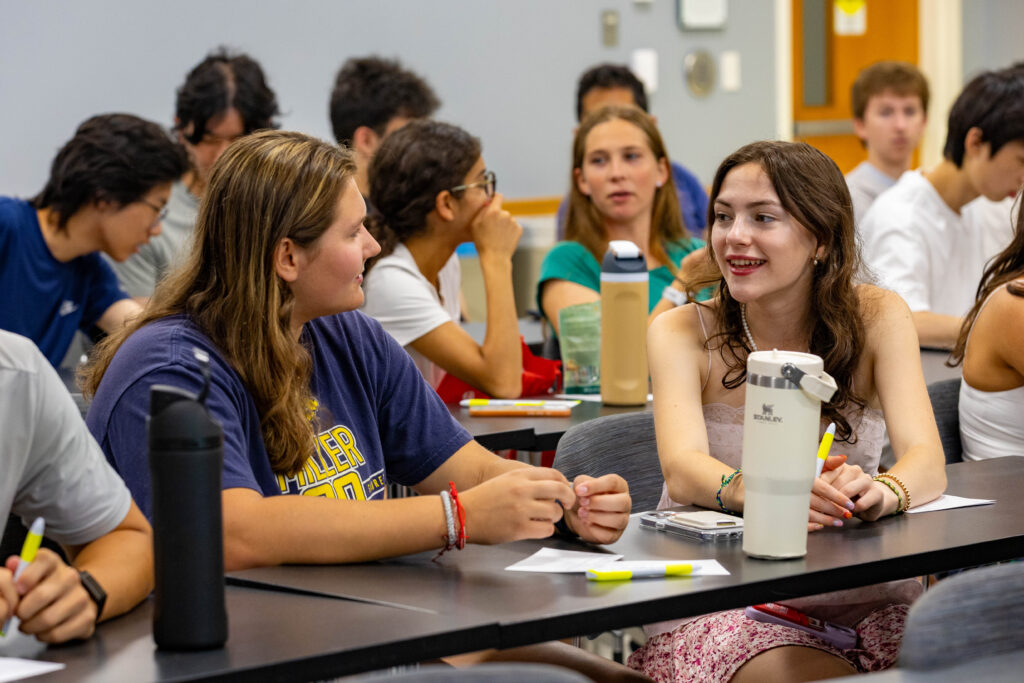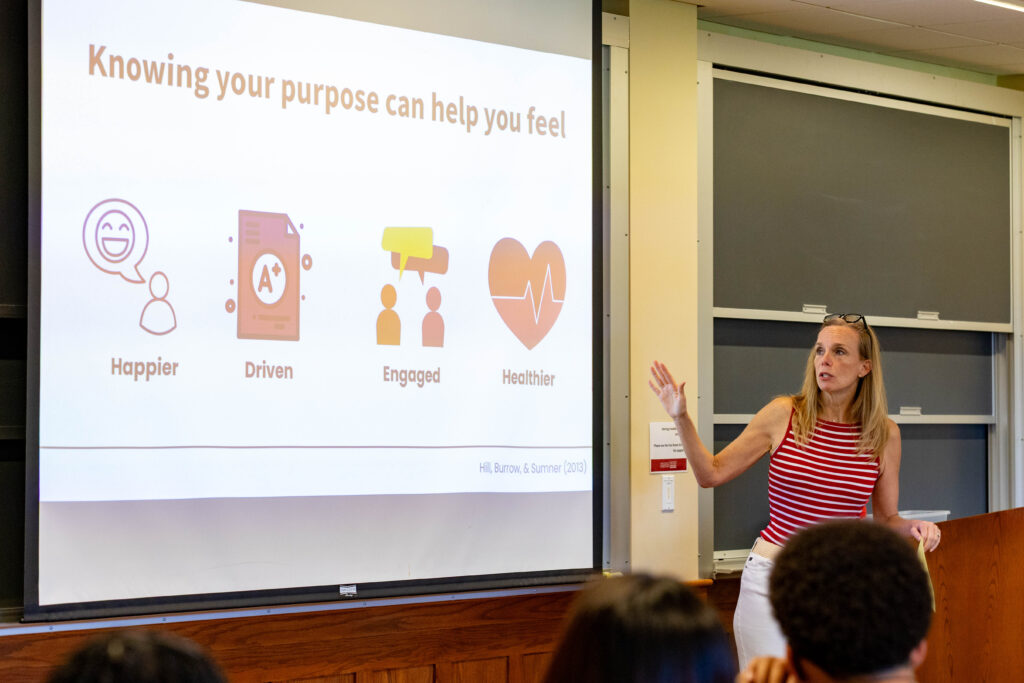
1,676 first-year undergraduate students shared what gives their lives meaning and purpose during an orientation session designed by the George and Carol Bauer Leaders Academy. What they wrote offers a glimpse into what drives the newest members of the WashU community.
The first year of college is a time of discovery. New students are exploring new interests, building new relationships, and taking steps toward building their futures. Washington University in St. Louis nurtures that process during first-year orientation by inviting new students to reflect on and develop an initial answer to a powerful question: What is your purpose?
Through the Bauer Leaders Academy’s purpose program, first-year undergraduate students reflect on their values, formative experiences, role models, and aspirations. Guided by WashU faculty and staff, they use those reflections to formulate a draft statement of personal purpose. The 1,676 statements submitted by the Class of 2030 provide a snapshot of what matters to WashU’s newest students.
Overarching Themes of Students’ Purpose Statements
An overarching analysis of students’ purpose students revealed five major underlying themes:
Striving to become your best self. One prevalent theme was living in pursuit of personal growth. Students wrote about intentionally living their lives driven by a desire to become more confident, resilient, thoughtful, and capable. They described purpose as something that develops over time rather than something that they simply find. Purpose, for these students, is something that emerges as an ongoing process.
Service, community, and impact. Students frequently described living in service to others–connecting their purpose with helping and contributing to their communities, supporting the people around them, and making a difference in society.
Pursuing curiosity and personal passions. Some purpose statements reflected an inherent desire to learn, live through the exploration of new ideas, and pursue subjects and activities that have a deep intrinsic value.
Becoming a trusted and supportive person. Relationships played a central role in many students’ statements of purpose. Students wrote about investing their time, energy, and talent in becoming people others–family members, friends, classmates, and community members–can depend on.
Achieving for family and future. Family was a prominent theme in many students’ statements. Students wrote about their hopes for the future and the people who have helped them grow to this point in their lives. Throughout these responses were references to family, career aspirations, financial stability, and future opportunities.
Themes within Academic Units
Although purpose is general and cross-cutting, students’ statements of purpose also reflected their declared academic units. Special themes connected to students’ academic units emerged:
McKelvey students want to engineer a better world. For students entering the McKelvey School of Engineering, purpose was often tied to their pursuit of technical excellence. Students wrote of using their expertise to solve important problems and develop innovations that can address global challenges.
Olin students lead with compassion and values. Students enrolled in the Olin Business School connected their purpose to achieving and leading in ways grounded in their values and a deep sense of responsibility to society.
Sam Fox students create art that expresses and connects. Creativity was central for Sam Fox students, who wrote of art and design as a vehicle for exploring ideas, expressing identity, communicating with others, and creating connections.
Arts & Sciences students pursue curiosity and personal passions. For Arts & Sciences students purpose takes shape through curiosity. Students noted the importance of living in a way connected to their personal passions and remaining curious and open-minded throughout their lives.
From Purpose to Leadership
As these 1,676 students settle into their first semester, their purpose statements are not a finish line but a starting point. The themes that emerged–growth, service, curiosity, connection, and aspiration–will continue to evolve and sharpen as students encounter new ideas, mentors, and challenges in the classroom, in student groups and activities, and in internships and jobs.
Our purpose in this work is not giving students a fixed answer, but helping them develop a habit of mind: the ongoing practice of asking why. That question will shape how they lead, learn, and contribute long after orientation ends.